
Rum finished in an agave cask, explained
It is rum. The agave is the barrel it spent its last months in, not an ingredient. That distinction is the whole article, and it is worth getting right, because the category confusion around it is easy to exploit and we would rather not.
Start with what it is
An agave-cask rum is a rum. It was distilled from sugarcane, matured in oak, and then moved for a finishing period into a cask that previously held an agave spirit. Then it was bottled as rum, because that is what it is.
No agave is fermented. No agave is distilled. No agave spirit is blended in. The only agave involved is the few litres of it soaked into the wood of the second barrel, and that is exactly how a sherry finish or a port finish works.
Rum, finished in an agave cask. Not tequila. Not mezcal. Not an agave spirit. Not a blend of rum and agave spirit.
What tequila and mezcal actually are
Both are agave spirits, and both are protected designations that can only be produced in Mexico.
Tequila is made from blue weber agave, in Jalisco and parts of four neighbouring states. The agave hearts are typically cooked in ovens or autoclaves, then crushed, fermented and distilled.
Mezcal covers a much wider range of agave species and a larger denominated area. The characteristic smoke in many mezcals comes from roasting the agave hearts in earth pits over hot rocks and wood before fermentation.
Neither term can be applied to a spirit made outside those denominations, and neither can be applied to a rum. A producer that leans on tequila or mezcal imagery to sell a rum finished in an agave cask is trading on a confusion, and the confusion runs in only one direction.
So where does the agave character come from?
The wood.
Casks used for agave spirits are usually American oak, and often had a life before that too. After a period holding an agave spirit, the staves carry both the oak’s own compounds and a residue of what they held. Put rum in, and some of that residue comes back out.
What tends to arrive is the vegetal, peppery, faintly herbal side of agave rather than the sweetness of the rum, which is why an agave-finished rum usually reads drier than the rum that went in, not sweeter. If the previous spirit was a smoky one, some of that can carry as well, though it arrives as a suggestion rather than as the roasted intensity of a mezcal.
Why anyone would do it
Rum and agave spirit are the two great non-grain, non-grape distillates, and they are made from plants that grow in similar heat. They share a green, vegetal register underneath the cooked-sugar one. Putting one in the other’s cask is a legitimate experiment rather than a gimmick, and it either works or it does not.
It is also an honest limitation of the technique that it is not repeatable at scale. A cask is a cask. When it is empty, the release is finished.
What we can and cannot tell you about ours
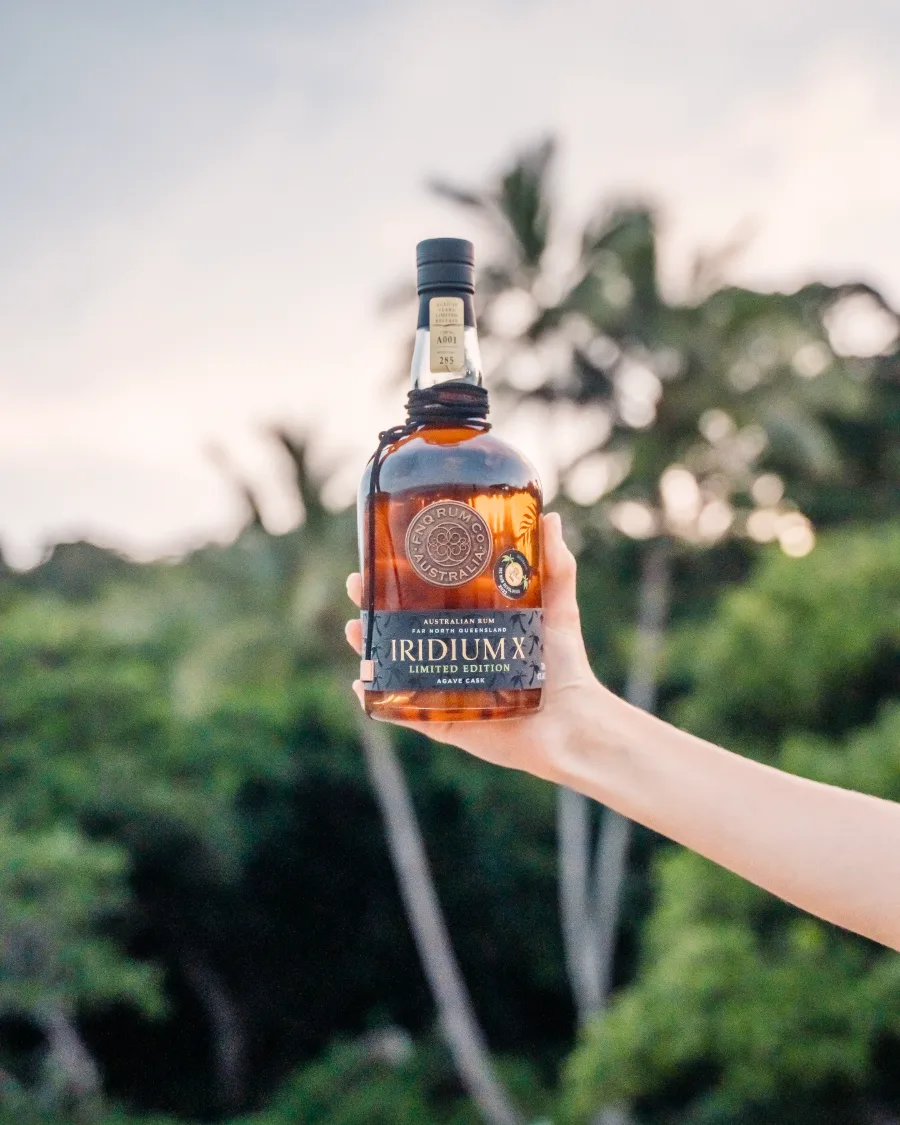
The Iridium X Agave Cask is a single barrel of ten-year Iridium X, bottled at 47% ABV, 240 bottles, recorded as cask A001. The bottle’s front label reads Australian Rum · Far North Queensland · Iridium X · Limited Edition · Agave Cask, and the neck label carries the cask number and a bottle number.
What is not published here, because it is not yet verified against a production record:
- which agave spirit the cask previously held, and whether it was a tequila, a mezcal or another agave distillate;
- where the cask came from and who coopered it;
- the cask’s volume;
- how long the finish ran.
Those are four good questions and an agave specialist would ask all of them. Guessing at any of them would be worse than the gap, so the gap stays until someone reads them off the fill sheet. They are on the outstanding production-information list, and when they are confirmed they will appear on the dossier and in the barrel record rather than in a press release.
How to taste it against a tequila
If you want to understand what the cask did, the useful comparison is not rum against tequila. It is this rum against the rum it was before the finish: Iridium X, same distillate, same age, same strength, without the second cask. The difference between those two glasses is the entire contribution of the barrel, and it is a more interesting fifteen minutes than any amount of reading.